The Sea King
Artist: Gibb II, Robert, RSA · 1845-1932
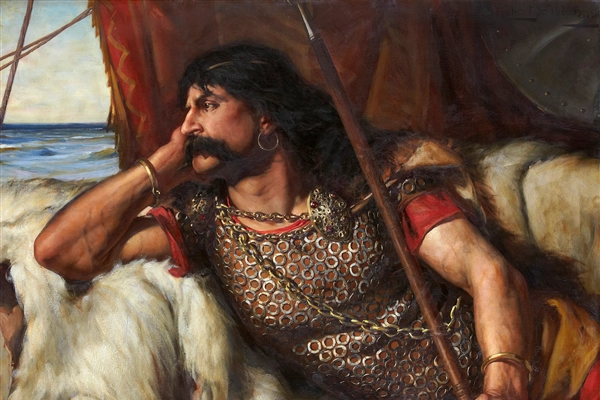
Although the iconography of the figure is Viking the appearance of the man is more Mediterranean and suggests that Gibb possibly worked from an Italian model as was the fashion at the time.
Gibb appears to have paid great attention to accuracy of costume. The intricate chainmail tunic or 'byrnie' that the figure wears is a potent symbol of his elevated status as such a garment was costly to produce and was only worn by Kings and leaders. The gold torques that he wears on each arm are also a display of his wealth and power and were often used as bonds between important figures and their vassals. The striking oval brooch that secures his cloak is very similar in style to 10th century examples in the British Museum and doubtless Gibb had carried out his research on Viking artefacts carefully.
In addition to his costume, his weapons clearly identify him as a Viking with the spear the preferred weapon of Viking warriors and the circular shield, that can be glimpsed to the top right of the painting, typical of the type used by Vikings. The choice of setting of a ship's galley and the seascape backdrop perfectly reflect the seafaring culture of the Vikings who travelled from their native Scandinavia across the seas to invade and settle in other northern climes such as Greenland, signified by the polar bear skin upon which the 'King' reclines, and northern and western parts of Scotland from the end of the 8th century AD thus anchoring the painting within the realms of Scottish history.
A similarly themed painting to the Diploma Work was exhibited at the Royal Academy in 1884, two years after his Diploma Work submission, "The Last Voyage of the Viking" catalogue number (287). This or a similar painting is reproduced on page 79 of 'The Dictionary of Scottish Painters 1600 to the Present' (Harris and Halsby, 1998).
"The Sea King" marks the last of Gibb's exploration of earlier historical periods. His most celebrated historical works deal with a much more recent and tangible episode in history. "Alma: Advance of the 42 Highlanders" and "The Thin Red Line" both depict events from the Crimean War of the 1850s.
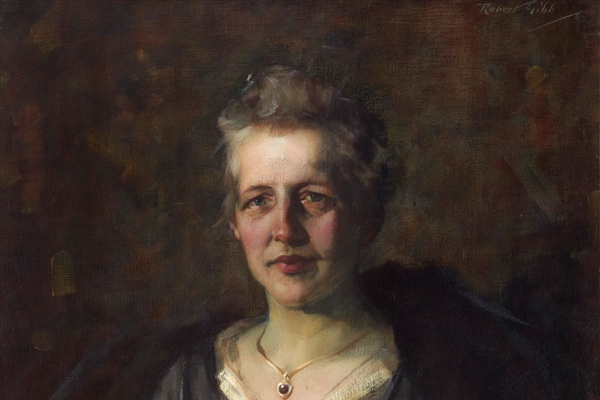
It was as a portraitist that Gibb was most prolific.
Additional details
-
Object data
Date 1882 Accession 2000.015 Type Painting Materials Support canvas
Medium Paint, oilDimensions Sight
87.9cm x 111.3cm
Frame
125.9cm x 148.5cmAcquisition Deposit, RSA Diploma Collection Gibb II, Robert, RSA (October 4th, 1882) -
Exhibitions