Royal Scottish Academy Academician’s Miniature Silver Dress Medal (uncased)
Artist: Paton, Joseph Noel, Sir, RSA · 1821-1901Recipient: McGregor, Robert, RSA · 1847-1922Medallist: Aitchison, James · 1839-1921

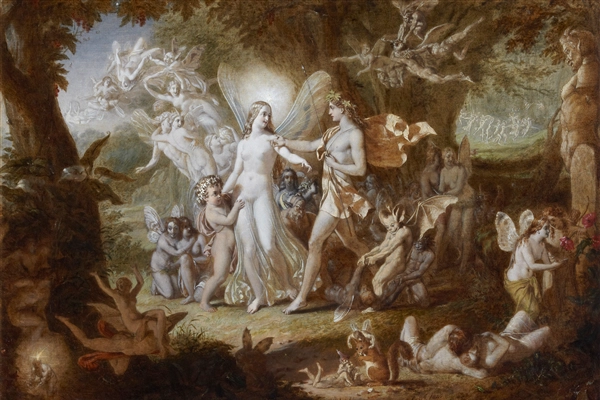
On 28 August 1850 at a General Meeting of the Royal Scottish Academy, it was first proposed that there be struck a Presidential Medal. This was to take the form of a medal suspended from a chain to be worn by the President. On 17 January 1853 the Academy sent two drawings (presumably showing the recto and verso faces) to designs by Sir Joseph Noel Paton to the London based Medallist and Dye-Sinker, Benjamin Wyon (1802-58). The 1851 RSA Annual Report (Notice VII) refers to the “protracted indisposition of Mr Noel Paton” which had prevented him from finishing the design for the obverse of the President’s medal and the new Diploma. “Mr Paton has supplied a finished drawing, on a large scale, of the Reverse of the Medal, which has already met the warmest approval of the Council and the Academy; his attention, since his convalescene, has been frequently directed to the remaining drawings, and the Council believe that at an early period they will be enabled to submit them for the inspection of the Academy.” The 1853 RSA Annual Report (Notice VII) continued;’ “The Council have been in frequent correspondence with Mr J Noel Paton RSA who, on the request of the Academy, had consented to give designs for the medal, to be worn as part of the insignia of his office by their President; and they eventually received from that gentleman, on 14th January, his matured designs for the obverse and reverse of this interesting work….” Wyon agreed to undertake to engrave the dies for the medal in a letter to D O Hill dated 25 January 1853. He wrote; “I feel gratified at being embursed by your Council with the execution of Dies from a design possessing so much beauty and originality as Mr Paton has succeeded in producing and which is so admirably adapted for medallion effect, and beg to assure the Council that I shall spare no pains in my endeavour to render the work as perfect as I can make it. I shall require about eight months time to complete the dies and 120 guineas….”
The President’s Medal was received in Edinburgh in time to be tabled at the Council Meeting on 12 March 1855 and Noel Paton thereafter was asked to design the chain and also the pendant by which to suspend the medal (RSA Council Minutes 15 and 27 March 1855). The RSA Annual Report for 1854 (Notice V) however suggests the medal had been received earlier; “The Council have now the pleasure of placing on the table of the Academy, the first impressions in bronze of the President’s Medal…..The Council have thought proper to await the decision of the Academicians, before directing that the copy to be worn by the president be struck in gold….It has been suggested in the Council, that copies of the medal should be struck in bronze or silver for each of the Academicians, their names and date of election being respectively engraved on the reverse….The Academy will also probably agree, that copies should be prepared and presented to those of the Honorary Members whose services they may wish so to recognize; and they will now have the power of marking their sense of the merit of Students, by awarding, with due care and discretion, bronze copies of the medal as leading prizes for merit.” The RSA Annual Report for 1855,(Notice IV) records that the President’s Gold medal was received on the day the foundation stone of the New National Galleries was laid, and (Notice V) that a bronze copy of it with the Keith Prize was to be awarded to Alexander Lauder as the most distinguished student at the last Annual Competition in the Department of the Antique in the School of the Board of Manufactures, and the same to be given to the successful candidate for the Keith prize in 1854, Robert Herdman.
An initial stock of 100 bronze and 40 silver medals was ordered from Wyon in May 1857 and were received by 27 October 1857 and the first had been engraved by Kirkwood by 11 December that same year.
Wyon’s original steel dies, the property of the Academy, are with Alex Kirkwood & Son, who succeeded Wyon as the medallist used by the Academy for making its various medals. They are protected from splitting by the addition of an outer collar and are preserved from rust by a layer of fine grease. The metal is annealed before being placed in the die-press and it can take several visits to the press to ensure that all the detail has come up satisfactorily. The medals are washed, dried, polished, given a light lacquer and then subjected to a final turn in the press.
The cases for the medals were originally made and supplied by W & J Milne, Stationers, 33 Hanover Street, Edinburgh, who agreed to make the boxes as per Noel Paton’s proposals; viz maroon morocco 4 ¾ inches (for bronze medals) and ditto rose morocco (for silver medals) all lined with the richest blue silk velvet at 8/- per case, to be blocked in gold (to Noel Paton’s design) at extra cost and the recipient’s name to be added at 6d per case.(letter W & J Milne to D O Hill, 29 May 1857) The initial batch of 60 (bronze) and 30 (silver) cases were delivered to the RSA on 22 December 1857.
The Associate’s medal was awarded by the Academy from 1857 until the Second World War. It was revived again in 1974 and from that date until the abolition of the Associate rank in 2005 Associates desiring a medal were asked to pay for it. (vide RSA Annual Report, 1974, Notice XVII “The presentation of medals to members on the occasion of their election – silver for Academicians, bronze for Associates – ceased when stocks were exhausted following the outbreak of war in 1939. The pleasing tradition of our members – and those that come after them – being able to possess these replicas of Noel Paton’s design of the Gold Presidential badge has been reintroduced, the circumstances of our times making it necessary for this to be against payment.”).
The hallmarking of the Academician’s silver medals commenced only in the late 20th Century.
A miniature version of the medals was also made by Alex Kirkwood & Son hung on a short silk ribbon (known both in blue and in maroon) and with a hinged clasp with legend RSA in raised lettering attached to the top edge of the ribbon. Kirkwood own the four dies for this (medal obverse and reverse, and clasp bar for each of RSA and ARSA). These dies are stamped Kirkwood and dated 1934.
The present medal was struck by James Aitchison, another Edinburgh silversmith and medallist. Aitchison was also responsible for the Academy's Maclaine-Watters medal.
The recipient of the medal was elected an Academician of the Royal Scottish Academy (RSA) in 1889 having previously been elected an Associate of the Royal Scottish Academy (ARSA) in 1882. The election is recorded in the Minute of the General Meeting of 1889-02-11; “The President and the Secretary retired to the Council room and examined the crossed lists sent in, and on returning to the Library the result was declared as follows; William Hole 14, Robert McGregor 6, J.C.Noble 5, J.H.Lorimer 3, G.W.Johnstone 2, D.G.Steell 2, J.D.Adam 1, George Aikman 1, C Martin Hardie 1, T.Scott 1. Mr Hole and Mr McGregor having received the greatest number of suffrages were put against each other for the first ballot and 12 voted for Mr Hole and 3 for Mr McGregor. Mr Hole was therefore declared duly elected an Academician.Mr McGregor and Mr Noble were then put against each other for the second ballot, and Mr Mcgregor received 11 votes and Mr Noble 4. Mr McGregor was accordingly declared duly elected an Academician.”
The ribbon has a metal fixing attached to its top edge which lacks the fixing pin and is attached to the medal by a small free-moving metal loop which in turn is fitted through a fixed loop atop the medal. The pin was concealed behind a small metal band bearing the raised lettering RSA (or ARSA for the bronze miniature version).
The dies for a slightly smaller (18mm diam) medal were made by Alex Kirkwood & Son, Edinburgh. They are dated 1935 and survive with the Company. In RSA Council Minute for 1935-02-20 it was recorded; “Medallions to be worn by members with evening dress were exhibited by Messrs A.Kirkwood & Son. It was decided to put the matter before the General Assembly.”
No record traced of the matter being brought before General Assembly nor Assembly of Academicians.
This would seem to suggest that the dies for the present medal were lost or destroyed on the death of James Aitchison in 1921, and that Kirkwood's were then entrusted with a new miniature version c.1934.
To mark the bi-centenary of the Academy in 2026, Kirkwood's were invited to quote for the provision of a new miniature medal using the same obverse design but incorporating the RSA 200 logo to the reverse.
© Royal Scottish Academy
Additional details
-
Object data
Date 1880 - 1889 Accession 2015.104 Type Medal, RSA Academician's Miniature Dress Silver Materials Support silver
Ribon silkDimensions 2.6cm x 0.3cm Acquisition Gift McGregor or Mansion, Margaret (1976) -
Exhibitions
Related work