
Significant Culture
Artist: Watson, Dominic · b. 1986
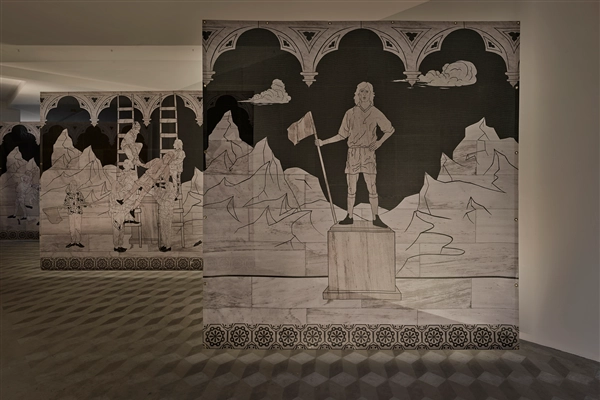
Whilst in Italy, Watson was inspired by the graffico marble floor in the Siena Duomo, Benozzo Gozzoli’s room filling frescoes in the Palazzo Medici-Riccardi, and the ideologies, myths and stories told through religious heritage. In Significant Culture he fed the gothic style of the Siena floor, and the composition and design of Gozzoli’s Renaissance masterpieces, into a myth he discovered in an entirely different Florentine culture – that of their football team Fiorentina, and their most famous player, Gabriela Batistuta. Batistuta remained loyal to the club following their relegation, despite tempting offers from bigger clubs, in homage to this, Fiorentina’s supporters funded a bronze statue of him that was erected outside the stadium. Some years later Batistuta joined one of Fiorentina’s rivals in Rome and the statue was removed. Although there is no official account of its fate, three myths have arisen: the total wanton destruction of the statue, its slow descent into ruin through neglect, or the ceremonial dismantling of the statue by fans and the distributing of its parts as relics, in the vein of Christ’s True Cross. Watson saw the allegorical narratives of the Renaissance in these myths and set about creating his own response. The artist’s own room-filling triptych encompassed the styles he encountered, but was translated through the medium of digital print on PVC banner mesh (the sort that adorns Florence scaffolding with representations of the buildings it conceals). It has featured its own artist-made patterned floor on the two occasions it has been exhibited; at its first showing in Nottingham the design was inspired by tiles found in Florence and at its second in Amsterdam, Watson created a three-dimensional pattern inspired by a Florentine church he had visited. Watson’s room installation is a contemporary satirical and personal interpretation inspired by the art, history, and culture, of the destination of the Kinross Scholarship. Perhaps more than any other Kinross deposit, it demonstrates how the divergent elements encountered as part of a travel scholarship can be channelled into an artist’s output. With Watson, like many of the other Kinross Scholars, the experience was revelatory and changed his practice, bringing drawing and narrative to the fore. ‘When you find yourself in this particular place or context then the narrative begins, because you also need a first point of reference or idea and that’s the beginning of a narrative in itself. So, what am I going to do here? How am I going to make work? That suddenly becomes the story, and that’s what I found when I was there. The doing is the making of the narrative.’ (Sandy Wood, from his 2018 essay 'An Evolving World : The Kinross Scholarship, Emerging Artists and the Royal Scottish Academy Collections')
The banner incorporates three different stages in the history of the gold coloured statue to Batistuta. In the first scene the statue stands repslendant, the figure holding a corner flag. There are three figures surrounding the sculpture and mountain peaks provide the background.
The second panel shows the moment the statue was taken down, there are a pair of stepladders with figures aloft passing the statue to others who wait foir it on the ground, ratherlike a renaissance deposition painting. To the left a figure stands holding the sculpture's corner flag horizontally.
The final panel depicts the breaking up of the statue and fans carrying off component elements of it as spoils. The supporters are seen dancing, singing, and two men at the right of the plinth have their trousers round their ankles, leaving them naked but for their boxer shorts.
© The Artist
Additional details
-
Object data
Date c.2014 - c.2015 Accession 2019.047 Type Print Digital Materials Support pvc mesh
Medium InkDimensions Support size, the image fills all of the support
250cm x 900cmAcquisition Deposit, John Kinross Travel Scholarship Watson, Dominic (October 10th, 2015) -
Exhibitions